
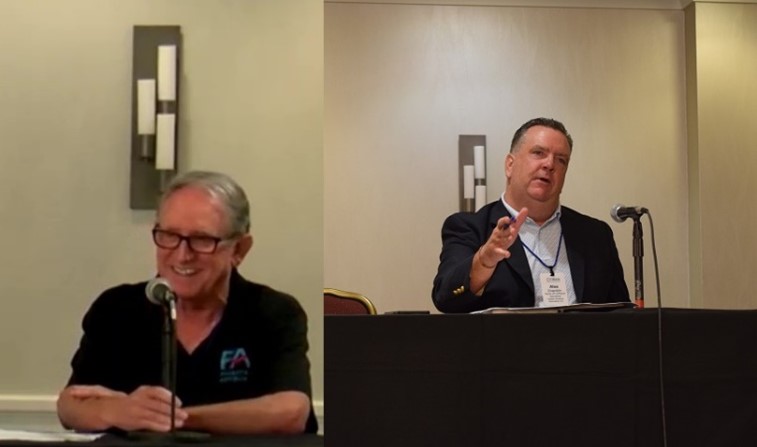
Gary Porter and Alex Chamblin
Why we need reserve studies
“You never have enough money in reserves,” declared Gary Porter, chief executive officer of Facilities Advisors International.
The reserve study, he explained, is a budget based on an analysis of a resort’s physical facilities. To balance that budget, “you either raise more money or reduce expenditures.”
Sources of funds include annual maintenance fees, special assessments, and bank loans. In April, the U.S. House of Representatives introduced HR 7532, the Securing Access to Financing for Exterior Repairs (SAFER) Act, triggered by the collapse of the Champlain Towers condominium in Florida in 2021. SAFER provides for low-interest loans to condominium associations, guaranteed by the U.S. Department of Housing and Urban Development, to provide money for exterior and structural repairs.
“Reserves have to be the financial responsibility of the association,” Porter said. “It’s got to be a significant amount. It’s got to be a maintenance-related activity, and it’s got to be a non-annual activity. So just for guidelines, conceptual principles that tell you this is what goes into reserves, you’re trying to keep this to be the big hit. Normal annual operating expenses go into the operating budget. They’re pretty much predictable and they’re pretty much annual recurring. The reserve budget handles the big-hit items and they can be all over the place.”
What’s a maintenance program?
Porter said a maintenance program “is what you do, the process you use to maintain your facility. A maintenance plan tells you what you should be doing. Many associations don’t have a formal maintenance plan.”
He emphasized that a reserve study is not a maintenance plan, but rather one small part of a maintenance plan because it tells you when to replace things or perform major repairs on a non-annual basis.
Porter said a maintenance plan has three goals:
• Safety.
• Maintaining, improving, and enhancing your property value.
• Protecting the lifestyle for which the resort was developed.
“In other words, if you’ve got a large swimming pool, water, splash pads, water features, if you’re not maintaining them, and that’s the reason people come to your resort, you’ve got a problem and you really need to make sure that these facilities are maintained,” he said.
“Maintaining lifestyle actually becomes for the timeshare industry perhaps more important even than worrying about the property value—but safety always needs to be there.”
Landscape beams
Porter used landscape beams as an example of a safety issue. “They’re protecting the landscape area and they’re being hit by soil and water, and being held in place by large steel spikes. Over time, those landscape beams tend to deteriorate, but the steel spikes don’t. I have encountered exposed steel spikes sticking up six inches in the air in New Jersey, in Colorado, in California.
“One of them was right beside a playground. Before I left the site, I said, go out, get a sledgehammer, pound that thing into the ground, do something with it, but don’t leave it sticking up.
“Another area to watch out for is playgrounds, from a safety standpoint. At one timeshare resort in New Mexico, the first thing I did on-site was look at their playground. I’m not a certified playground inspector, but I just looked at it and said, ‘You guys are violating every safety factor imaginable. Simply tear this thing down, get rid of it. It’s a liability. It’s not an amenity.’ Those are things to consider.”
Porter told of a 70-year-old wrought-iron fence at Disneyland that is painted every day. “It’s never been replaced, and it never will be replaced because they maintain it perfectly,” he said. “Think of balcony railings, think of the perimeter steel fencing around the resort. How many times have I had to tell a resort, ‘You’ve got earth-metal contact here and you’re rotting this thing out from the bottom up. You’re going to have to replace it. For every dollar spent on preventive maintenance, you’re saving $6 on replacement downstream. Now, think of what this costs your resort. You could actually spend more money on maintenance now, but you could eliminate or significantly reduce your downstream reserve expenditures.”
In the wake of the Champlain Towers collapse, a new Florida law focuses on structural inspections and reserve studies, but “they don’t stop buildings from falling down,” Porter said. “Maintenance is what stops buildings from falling down.”
Ten dos and don’ts
“Many boards over the years have defied or tried to defy the best practices, and they’ve paid a heavy price for it,” said Rich Muller, executive vice president of VRI Americas and Trading Places International. “We also have to recognize that our planning and funding and timelines have all been upended by inflation, supply-chain issues, lack of labor, and lack of available skilled tradespeople. But the best practices have not changed, and arguably they are even more important today than they ever have been. So let me give you ten dos and don’ts:”
1. You must have a plan. A reserve study looks ahead 30 years in the future. Boards need to know in finite detail what is needed this year and over three and five years, so they can see how one year’s renovations play into the next. The plan must be a working document, updated constantly.
2. There’s never enough money, and you have the duty to break that news to your owners. “The problem started early in this industry with developers who kept maintenance fees artificially low and then turned over governance to a board that didn’t want to raise maintenance fees. All of us inherited that and we’re paying the price.”
3. Do unit renovations on a regular cycle. Some resorts are fortunate enough to stay on cycle because they budget enough annual assessments to cover their reserve contribution. Others rely on loan financing, a very useful tool. If you have to use a special assessment, you’ve got to communicate. The owners have to see visible results. If you’re going to paint, change the color. If you repaint your buildings the same color, nobody’s going to notice.
A general rule of thumb for renovations is five to six years for all soft goods (carpets, drapes, window treatments, upholstery, etc.) 10 to 12 years for soft goods plus all of your case goods and furniture, 15 to 18 years for soft goods, case goods, and major rehab (kitchens, bathrooms, etc.). Remember hallways and common areas. Mechanical, structural, and hardscape must be plugged in on their own timelines, along with amenities (pool, tennis courts, paving, fitness rooms). All of these need to be scheduled. The problem is, by deferring they all need to be done at the same time and everyone wonders how they’re going to pay for it.
4. Piecemeal replacement is one of the most inefficient and impactful and expensive ways of performing unit renovations. Once you go off cycle, getting back on is difficult, and piecemeal purchasing doesn’t allow for economies of scale.
5. Phasing is essential and should not be confused with piecemeal. If you’re applying for a construction loan or line of credit, you shouldn’t borrow money and pay interest on it when you don’t need to use it immediately.
6. There is a huge and costly difference between getting the full, useful life out of your furniture, fixtures, and equipment, and deferring—or worse—ignoring the inevitable. Catching up is exponentially harder and more costly, and sometimes impossible.
7. Don’t be penny-wise and pound-foolish. Your maintenance team can’t do it all. They have a role to play, but for something like painting that can’t be interrupted, bring in professionals with the right equipment who can save man-hours and get the job done. Also hire professionals who know the difference between residential- and commercial-grade furnishings. Have an attorney review your contracts. Don’t just go with the lowest bid.
8. Always do a model unit. Don’t make the mistake across 50 rooms. We have never done a model unit that has actually been 100 percent copied throughout the rest of the renovation.
9. Don’t underestimate your owners’ support, but don’t overestimate the appreciation you’re going to get for making hard decisions. Owners want and are willing to pay for improvements. We need to assess enough. We can’t assess too much. We get the same grief. When boards have tried to do a $50 assessment versus a $500 or $1,000 assessment, we get the same complaints. Communication and buy-in is essential. Show them the plan.
10. It’s all about the money, and funding reserves is always the biggest challenge.
Recruiting new members
“One of the biggest issues that I see for all of our resorts is the ability to get new dues-paying members involved in the association so we can keep the maintenance fees at a reasonable cost, with additional revenue coming in to fund projects, and capital reserves that we need to ensure that our associations look the way they’re supposed to look,” said Alex Chamblin, senior vice president of resort operations for Capital Vacations.
Thus, he emphasized the importance of marketing and sales to drive revenues to the resorts’ owners associations.
Chamblin said Capital Vacations will spend $100 million in marketing and sales costs for the associations that the company manages, and another $20 million giving maintenance fees to those associations. It also helps those associations find funding, through revenues or a loan, to generate reserve dollars for renovations.
“And then it becomes a cycle of being able to pay back the reserves loan and then funding reserves on into the future,” he concluded.
For information on upcoming TBMA events go to: tbmassoc.org/conferences